Te Akau Station - History
Te Akau Station is stepped in History
Hiking around the land shows preserved Historical land marks of Marae sites, Kumera pits still recognisable all these Years later.
The following historical notes are from the Waikato District Council archives.
After the Waikato War of 1863-64, the government confiscated the land between Whaingaroa and Port Waikato; more than 90,000 acres.
It became known as the Te Akau Block.
In 1866 the Crown returned the land in separate large parcels to named members of Ngati Tahinga and Tainui Awhiro, plus a small area to Honana Maioha of Ngati Mahuta who had been working on land at Te Horea.
Disputes arose between the iwi as to boundaries and ownership of the land.
These disputes were heard, but not settled satisfactorily, in various courts such as the Maori Land Court and the Compensation Court through to the early 1900s.
From 1868 the Te Akau Block was leased from Ngati Tahinga and Tainui Awhiro and run as a sheep and cattle station, first by South Island runholder HC Young, who soon went into partnership with Christchurch shipping agents, Miles, Hassall & Co.
The property remained undeveloped until 1874 when the first shipment of 10,000 merino sheep from Canterbury arrived with shepherd James Burgess. Pasture was sown, buildings and yards were built and a large staff of Maori and Pakeha was employed.
In February 1877 the lease was taken over by two other South Island run-holders, brothers John and Michael Studholme, in conjunction with Auckland entrepreneur Thomas Russell.
Financial difficulties saw Te Akau Station taken over by the New Zealand Land Association (part of the New Zealand Loan & Mercantile Agency Company) in 1890. It became the largest sheep station in the district.
The main homestead for the station manager was at Te Horea but other houses and farm buildings were situated further north at Mangati, Ohoka and Maratai.
The homestead was extended in 1885. At one time it was known as ‘Bachelor’s Hall’. In 1881 a visiting correspondent described the homestead, groves of peach trees, a substantial woolshed, stables, meat shed, butchery, saddlery, sheep dip.
In 1894 a house used as the men’s quarters was destroyed by fire. A flax mill was established in 1889 by a Mr Hall up the coast at Tauterei Stream.66 In 1906 the mill was run by Rutherford, and was still operating in 1907.
The wool clip, flax and other commodities were loaded on to boats at a small bay below the farm buildings, a store shed being erected there to protect outgoing and incoming freight.
A jetty built below the homestead, at the end of a flight of limestone steps, allowed for easy access to Raglan.
Over the years the different managers played prominent roles in Raglan social and community events. People visited from Raglan for annual picnics, to play in the sand dunes and inspect the spectacular limestone outcrops.
The Crown acquired then sold off portions of the Te Akau Block.
The Te Akau Road was improved in the early 20th century and a new jetty, to replace the jetty at Te Akau Station, was built to provide better access for people living in the Te Akau area.
Reference: https://www.waikatodistrict.govt.nz/docs/default-source/your-council/plans-policies-and-bylaws/plans/district-plan-review/section-32-reports/historic-heritage/wdc-historic-overview---7-raglan.pdf?sfvrsn=e57a6dc8_1
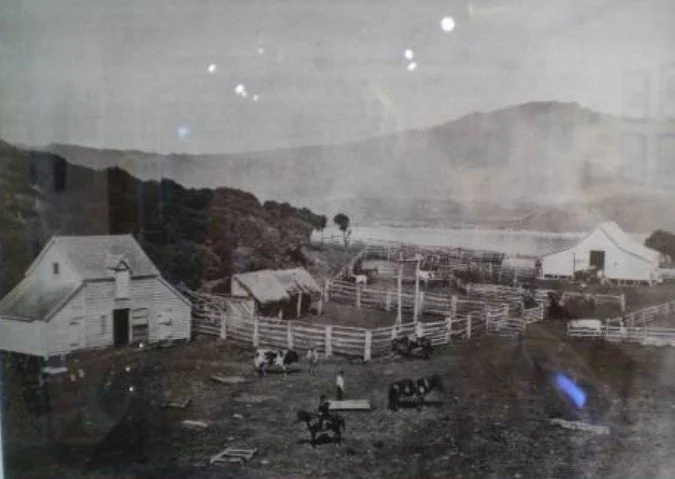
A view of the farm buildings and yards at the Te Horea end of the station. The shearing shed had 16 stands. Whaingaroa Harbour and Mt Karioi are in the background. Photographer Rev. William Slade, early 1880s. X001.82.2, Raglan Museum.
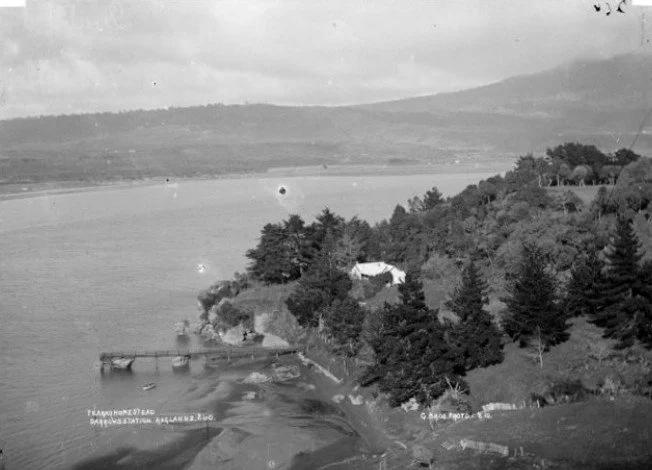
Te Akau Homestead (Burnt down in 1894) on Darrow’s Station, Te Akau, near Raglan.